 Train crews and support personnel
Content provided by Those Classic Trains
Train crews and support personnelThe railroads were the greatest single employer during the late 19th through mid-20th centuries - a distinction held today by the various levels of government bureaucracy.
A railroad job was (and still is) considered the best blue collar or middle management spot one could hope for: security, travel and romantic flair in a career that really helps to shape our way of life.
Little boys envied the lordly presence of the conductor while little girls romanticized about the heroism of Casey Jones (not recognizing the grim realities behind the legend).
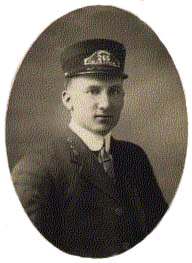
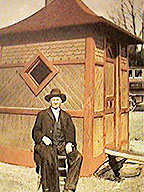
So much has the railroad man become a part of our way of life that even an obscure conductor of the small Port St. Joe RR has been immortalized in this turn of the century cameo postcard.
In this Topic, we look at the human face of Passenger Service to see who it is that makes the Golden Age what it is.
A typical passenger train can have a staff and crew of 30 or more. These, in turn, represent various operating departments within the railroad (or in some cases, of more than one railroad) as well as Pullman, REA and the U. S. Government. To say, then, that daily operations involve a lot of diplomacy (and occasional knocking heads together) is no exaduration. Here is the political structure of the typical passenger train.
Conductor |
Pullman Representative |
Dining Car Steward |
RPO Chief Clerk |
Express Messenger |
Road Superintendent |
Pullman |
Commissary Department |
Railway Mail Service District Superintendent |
Express Agency District Manager |
| . | . | . | . | . |
engineer |
porters |
1st, 2nd, 3rd cooks |
RPO clerks |
. |
fireman |
club car stewards |
helper |
(may number 1-12) |
. |
head end brakeman |
club car cooks |
dining car waiters |
. | . |
rear brakeman |
train secretary |
. | . | . |
| .. | barber |
. | . | . |
| . | maid |
. | . | . |
The Conductor controls the actual movement of the train, receiving movement clearances from the Dispatcher and directing the locomotive crew and brakemen. In the case of a combined train, each road will have a Conductor for its respective consist, with the one whose road they are presently traveling over being designated as senior Conductor (and thus in overall command).
Interestingly, for most railroads, passenger trains are the responsibility of the Road Superintendent, who has his own problems in getting freight, equipment movements and MoW over the road. This is one of the weaknesses of passenger operation which has never been adequately addressed.
Contributing monograph:
Pullman normally owns and controls the sleeping cars, baggage-clubs and observation cars, providing their own crews for them. As these account for the great bulk of the train crew, a representative is assigned by Pullman to provide overall control and monitor the condition of Pullman property. In this capacity, the Pullman Representative is a formidable authority figure, who can cut a defective car out, discipline or remove porters and other staff and who handles the receipts for "shorts" who board en route or who want to upgrade their accomodations.
However, while the Pullman Representative is the second most powerful person on board, he is not a railroad employee and thus does not have any authority over train operations or movements: a fact carefully drummed into them. As a practical matter, however, the Pullman Rep often works closely with the Conductor as an informal second in command. On long distance runs, the Conductor and Pullman Representative will each have their own compartment: generally those in the observation car.
Contributing monograph:
Almost all diners and some lounge cars are owned by the railroads, who supply their crews through the Commissary Department. This is especially true after 1947 and the breakup of Pullman. The leader of the dining car crew is the Steward. In cases where there are both railroad staffed dining and lounge cars, the latter will have a lounge Steward. However, as lounge services are usually a one man operation, a lounge Steward does not enjoy the same social status as his compatriot in the dining car.
The dining car Steward has a number of specific responsibilities:
As with the Pullman Representative, the Steward is generally a white man while most of the staff are from other ethnic groups. This is done, as with the Pullman Rep, so that the mostly white passengers do not have to interact with a black or latino authority figure.
Interestingly, as the dining cars are owned and staffed by the railroads, diner crews have benefited from improved living conditions on board. As more and more trains operate in multi-road through long haul, the practice of cutting the diner in and out has declined. As crews stay with the train for up to 3 days, dormitory facilities are often provided.
In some cases, these take the form of an old heavyweight section Pullman leased for non-revenue duty (the porter is not provided). The most popular is the venerable 12-1, as the drawingroom can be used by the Steward. Among the newer lightweight streamliners, many dining cars are twin units- having the dining section in one carbody and the kitchen, pantry and crew dorm in the other.
The Chief Clerk commands the RPO car, with the most senior man being in overall charge when more than one working RPO is involved. He is answerable to the District Superintendent of the Railway Mail Service of the U. S. Post Office and, in turn, commands the RPO clerks (who many number as many as a dozen) on board.
These are the only employees on the train who are normally armed: carrying revolvers, shotguns and, in some cases, hand grenades. The crew of the RPO have their own problems and do not normally mingle with other train personnel. As most work a specific route, they are rotated off after a set time and do not need meal or dorm facilities.
For further information about the Railway Post Office, see "The RPO And The REA".
It is rare to see more than one Express Messenger on a given train unless there are several working Express cars, in which case there would usually be one Messenger on each car. As with the RPO, the most senior man is designated in overall charge, although for practical purposes Express operations are run by committee of the Messengers present (who help each other with bulky parcels or talk things over and agree on a course of action).
As with the RPO, Express Messengers usually stay with their car and do not mingle. Also like the RPO, Messengers may be armed, particularly on cars equipped with valuable shipment safes.
Just as a train has its crew, so are there people on hand at various points en route to supply technical support. A big city terminal is practically a small town in its own right with hundreds of employees on duty. Even a smaller regional station will have a team of technicians and custodial people on hand for routine checkups and minor repairs. These are some of the railroad people one is likely to encounter in the course of a journey.
What the porter is on the road, the Red Cap is in the terminal. Indeed, most Red Caps come from the same social origin - black males - and labor under the same conditions as their mobile counterparts.
Red Caps are generally subcontractors, operating with the blessing of the terminal management but receiving no return other than the passenger's tips. As with porters, they are subject to strict and often arbitrary discipline. Unlike their bretheren, they also face the uncertain weather conditions of a blistering hot or rain soaked or numbing cold station platform. Moreover, as their service to and contact with the passenger is usually brief, tips are nowhere as good as porters enjoy.
Still, in a day prior to Civil Rights legislation, a spot as a Red Cap at a big city terminal is one of the better jobs a black man might hope to hold. Many porters suspended or dismissed by Pullman have wound up decorating the platform.
The Commissary Department replenishes critically needed food and potable water, beverage and refrigeration ice, liquor, linen, tablewear and flower settings according to a preset plan or in response to orders dropped at the previous station by the Steward. This involves the diner(s) as well as the club car at the head, the lounge-obs at the rear and any midtrain buffets. These supplies are delivered to trackside by truck, or in the case of the major terminals, by a battery operated rail jittney.
Diners pose a particular problem - drinking water and ice - which involves a certain amount of gymnastics. Most dining cars carry their potable water in overhead tanks which drain down through the cookstove to provide hot water. These overhead tanks have to be filled via roof hatches, along with the ice for the "ice boxes" (a term still used today for a domestic refrigerator - until fairly recently, they really were "iced" boxes).
Icing and watering are normally done at the major terminals where adequate facilities and time can be had. When reprovisioning must be done in the field, it creates major headaches. For the most part, it is not really practical to build an overhead walkway on the terminal platform, so icing and watering must be done by an elevated truck.
This may involve a standard box bed truck with a wood roof: commissary men hand up the filling hose and bagged ice, then man the pumps while one of them on the truck roof handles the hose. In a few instances, this tedious task is expedited by a truck body that raises on a huge scissors jack to bring the cargo bed to cartop level. However, these are less common in these days of cheap labor.
Whenever a passenger train stops at a city of any real size, a tense human drama is played out. The passengers embark and debark, baggage is quickly exchanged, RPO and express is transferred. At the same time, and unnoticed by most, the train is swiftly serviced by the Car Department.
In the mean time, the locomotive is either changed out or its working mechanism is given a quick check by the roundhouse forces: one Shopman going around with a wire scrub brush to clear away the grime and check the spot welds on the piston slides while others refill the power lubricators and pack grease into the Alemite fittings with their huge air powered grease guns.
As much as some people despise the railroads as crass exploiters of their near monopoly on transportation, the railroad industry has long been a leader in social opportunity and employee benefits. Here are some of the areas where the industry has set the standard others follow:
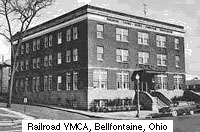 A more typical example is the railroad sponsored
YMCA, found in most major cities and available to railroaders and their
families. These double as social centers and overnight accommodations for
road crews.
A more typical example is the railroad sponsored
YMCA, found in most major cities and available to railroaders and their
families. These double as social centers and overnight accommodations for
road crews.
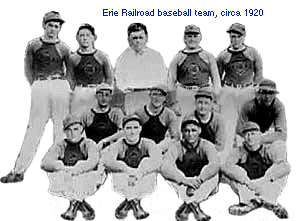
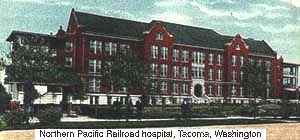 Railroading has always been a hazardous
calling, especially in the early days of hand brakes and link-and-pin couplers.
As such, the railroads have long had a close working relationship with
the medical profession.
Railroading has always been a hazardous
calling, especially in the early days of hand brakes and link-and-pin couplers.
As such, the railroads have long had a close working relationship with
the medical profession.
 Workman's Disability
*****
And in the end, the railroad man and his family can find a final resting place in the cemeteries many roads have established for their own.
| Home Site Map Search Contact |
North East Rails © Clint Chamberlin. |