 The Florida East
Coast Railway came about as a result of a devoted husbands care for
his ailing wife. In 1880, northern Florida was beginning to draw notice
as an out of the way vacation spot.
The Florida East
Coast Railway came about as a result of a devoted husbands care for
his ailing wife. In 1880, northern Florida was beginning to draw notice
as an out of the way vacation spot.Content provided by Those Classic Trains
The Florida East
Coast Railway came about as a result of a devoted husbands care for
his ailing wife. In 1880, northern Florida was beginning to draw notice
as an out of the way vacation spot.
Among these was one Henry M. Flagler. At age 60, he wearied of the bearpit existence of an associate of John D Rockefeller. His wife (to whom he was devoted) was ill and it was thought that an extended vacation in the mild Florida climate would do wonders for all concerned. Upon arriving at St. Augustine, however, Flagler found that this pleasant little town of 2500 - despite its charms - was a bit too rustic for Royalty.
In particular, it lacked a decent hotel. This was an annoyance to be endured by VPs and Regional Managers. For a man with Flaglers wealth and connections (and the drive that let him run with the Wolves of Wall Street) this was no problem. With an unerring eye for the main chance, Flagler recognized Florida's potential for high-end tourism. So, with $1,500,000 of his own money, he built one of the most opulent hotels yet seen on the continent: the Ponce de Leon.
At the same time, he began establishing links to the northeast by snapping up the J St A & H, upgrading and extending it down along the Atlantic seaboard. When the Ponce de Leon opened in January, 1888, it was an immediate success. Money looks after Money, and St Augustine soon became a favorite stomping ground of Flagler's social circle.
In the mean time, passenger service from Jersey City (NYCity) started flowing in: beginning in December 1884 with a single through sleeper (via ACL), and following in January 1888 with the first "Florida Special". This terminated in Jacksonville and the passengers were ferried across the St. Johns to continue via the JStA&H.
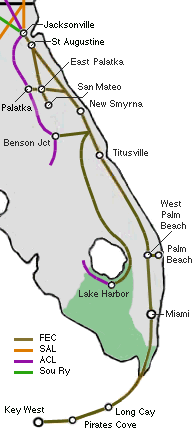
With connections made at last and his Ponce De Leon a smash success among the smart set, Flagler went on a development binge, determined to turn this tropical cracker wilderness into the American Riviera. The FEC pushed steadily south, with world class resorts sprouting along the coast like mushrooms, until it reached Knights Kay at the southern tip of Florida, in 1908.
Tourism was a solid money maker and Flagler's speculative venture was paying off handsomely. But other roads were jumping on the bandwagon: the Atlantic Coast Line, which was building a competing line through central Florida toward St Petersburg on the western coast; and the Seaboard Air Line, which had just absorbed the regional Plant System and was also targeting the west coast.
Having reached the southern end of Florida, Flagler was eying nearby Cuba, which, after being liberated from Spain in 1898, was getting into stride as a tourist mecca of its own. Roughly half way between south Florida and Cuba, at the end of a chain of reefs and islands, was Key West. Like so many of Flagler's interests, this was a grubby village on a remote island whose only claim to fame was a port facility which had been abandoned by the U.S. Navy after the Civil War- and that it was half way to the glittering tropic oasis of Havana.
So- with perhaps more enthusiasm and ready cash than common sense- Flagler pushed the FEC out to sea, leapfrogging along a chain of reefs and islets with a trestle causeway no less than 128 miles long. In the mean time, the port facility was refurbished, yet another tropical palace was built, and a steamship line developed to provide Key West to Havana connections. The Key West Extension was completed January 22, 1912. Passenger service to Key West and Havana began the same day.
By now, a Florida land boom was developing. With freight and passenger traffic swelling, the FEC began double tracking its entire length from Jacksonville to Key West. By the mid 1920s, when the boom reached it's height, the FEC was a state- of- the- art big time railroad in every respect: double tracked, automatic block signals and current generation USRA copy 4-8-2 passenger power.
But as quickly as the boom came, so it went. By the late 20s, the Florida economy was sagging. Freight (mostly building materials) was being embargoed because the recipients had no place to put it. One desperate builder actually smuggled a car load of bricks south by mislabeling it as lettuce (arranging to have the load duly iced enroute). The smart money got jittery about the tenuous state of the building industry and pulled out. Tourism and population influx sagged sharply. Shortly thereafter, the Panic of 1929 brought the Florida economy to a grinding halt. Freight and passenger loadings dropped by 50% compared to 1924. Overbuilt and overextended, the FEC went into bankruptcy.
Since then, the FEC has continued to operate under receivership, relying on Flaglers legacy of a first class chain of resorts to support the continuing seasonal passenger trade. In 1935, the Key West Extension was destroyed by a hurricane. At the time, one consist of the "Havana Special" was trapped at Key West and eventually brought back by ferry, evoking a headline:
Considering the financial state of the railroad and the economy in general, and in view of the limited traffic to Key West, the extension was never rebuilt. It has since been sold to the US government, which is using it as a right of way for a new highway.
Florida tourism never fully recovered from the Great Depression. The FEC continued to serve as the connecting link to lower Florida despite declining passenger revenues and poor general economic health until a labor conflict evoked a crisis in late 1962. At that time, the railroad decided to drop it's Trainmen's Union contracts and run with management and new hires. Using the excuse of rampant labor violence, the last passenger trains were discontinued at the start of the 1962-63 season and the remaining through cars routed over the Seaboard Air Line.
NOTE: refer to The Glossary for a summary of how to interpret the train listings below.
Effective 6/35
Note: this is the reduced summer operating schedule. For the winter operating schedule, refer to "The Florida Trade: Part 3".
General Notes:
All trains are met at West Palm Beach by motor coaches of the Poinciana Transfer Company for connections to Palm Beach.
The large modern steam power (at least those that weren't sold off during the Depression) are concentrated on the through traffic of the Florida Trade. Typical local service motive power is assorted 4-4-0 and 4-6-0 types. An 0-6-0 switcher may be used on the East Palatka shuttle if a relief engine is needed: the only known instance of an 0-6-0 in revenue passenger service.
As FEC has been selling off some of its surplus laid up equipment (although the demand is not what they were hoping for). So while local trains have the best available equipment, these are mostly wood head end and coaches and older steel RPO / express cars; with 15' and 30' RPOs.
Distinctly different from their Florida Trade operations, FEC local operations are of the most limited and highly localized sort, with outdated equipment running through the back woods on erratic timetables connecting otherwise isolated small towns. Most FEC locals are connecting trains to backwoods branches of other area railroads.
One notable exception is the East Palatka shuttle, which links the ACL Orlando Division with the FEC main via the Palatka loop. However, as the ACL parallels the FEC in this region, Palatka is primarily of benefit to regional traffic down from central Georgia via the Southern Ry.
For information on FEC joint long haul services, refer to "The Florida Trade".
| Home Site Map Search Contact |
North East Rails © Clint Chamberlin. |